Why Organizational AI Needs Epistemic Infrastructure
Federico Bottino, Carlo Ferrero, Nicholas Dosio, Pierfrancesco Beneventano
Paper, Preprint, arXiv preprint (cs.AI), 2026
Abstract
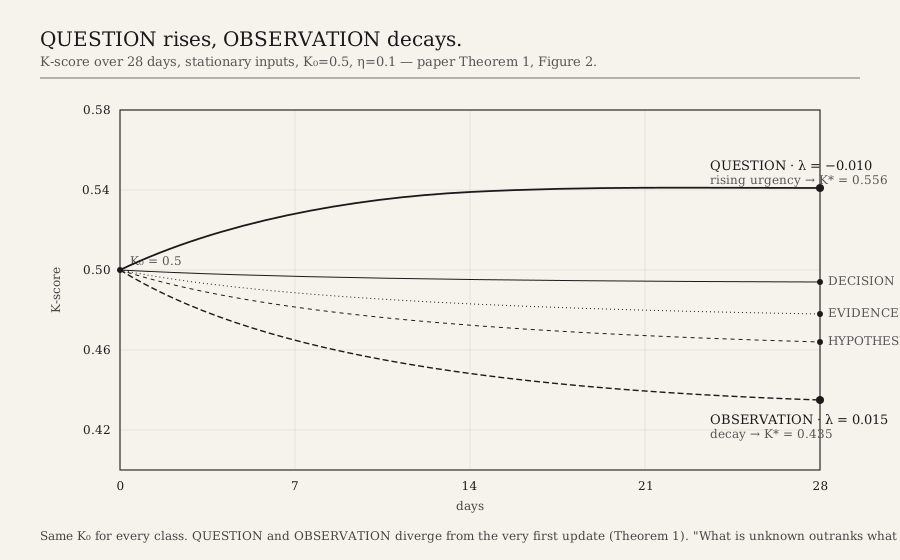
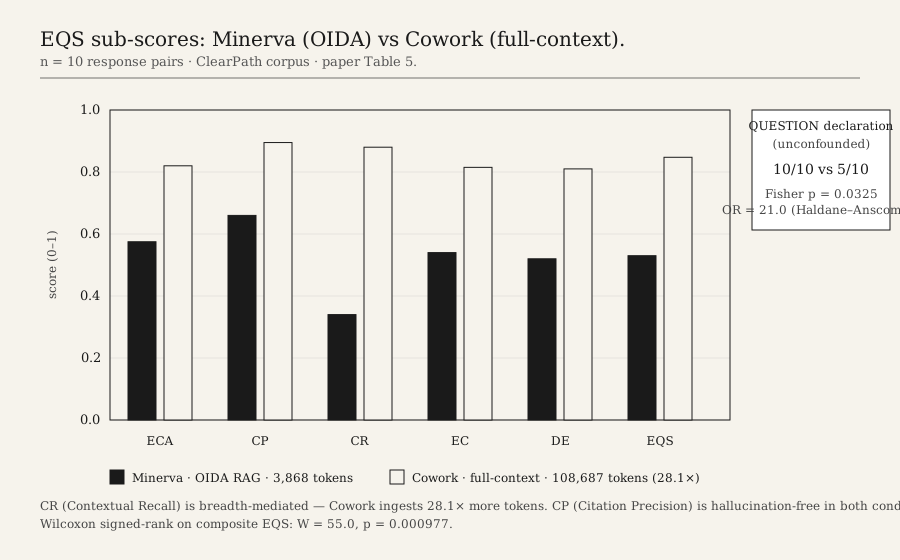
Retrieval-Augmented Generation has become the default way of plugging an LLM into a company's documents. Inside real organizations, retrieval alone is not enough. An organization needs to know what it holds to be true, what is contested, what it is committed to, and — above all — what it doesn't know. We present OIDA (Organizational Intelligence and Decision Architecture), a framework that represents organizational knowledge as typed objects with epistemic properties: commitment strength, contradiction status, provenance. The central piece is QUESTION-as-modeled-ignorance: a primitive that turns 'we don't know' into a first-class object the system can plan around, instead of filling the gap with a plausible-sounding sentence. We also propose an Epistemic Quality Score (EQS) to evaluate not how fluent an answer sounds, but how honest it is about what it doesn't know. In our experiments OIDA reaches an EQS of 0.530 with 3,868 tokens, against 0.848 for a full-context baseline that uses 108,687 tokens — about 28× more. The QUESTION mechanism shows a statistically significant effect on outcome quality (Fisher exact, p = 0.0325).
I work with companies that try to put AI on top of their internal knowledge. Funds, R&D teams, public bodies. The model is almost never the part that breaks. The part that breaks is how the knowledge around the model is represented. Standard RAG returns paragraphs that look right and quietly hides the things the organization actually depends on: open contradictions, weak commitments, the questions nobody has answered yet. That is the gap this paper is about.
Standard RAG treats every chunk of text as equally true. OIDA splits this into three things that should never have been the same thing: what the organization knows, what it is committed to, and what it doesn't know. Each one becomes a typed object the system can reason about. The QUESTION-as-modeled-ignorance primitive is the part I care about most. It lets the system say 'I don't know, and here is the shape of what I don't know', instead of producing a confident answer.
I co-designed the framework, worked on the QUESTION primitive, and built the EQS evaluation. EQS is a strict metric on purpose: it does not reward fluent confidence. The headline number is that OIDA gets to about two-thirds of a full-context baseline at less than 4% of the token cost — and surfaces the ignorance the baseline was hiding.
Inside an institution you usually don't want a system that always answers. You want one that knows when not to, and exposes the gap so a person can close it. That's the direction I'm pushing on with this work.