Maryam Fooladi, Federico Bottino
Paper, Information Disorder Workshop (InDor) at LREC 2026 — Palma de Mallorca, 2026
Abstract
Most AI systems aimed at the modern information landscape are built as a single monolithic pipeline: ingest, classify, output. That works on a benchmark. It falls apart the moment a real institutional analyst — a regulator, a media-literacy team, a strategic-foresight unit — has to use the result. The paper proposes a four-layer architecture instead. (1) A strategic layer for narrative shifts, ideological framing, long-horizon signals. (2) An operational layer for source extraction, entity and event monitoring. (3) A compliance layer that carries the regulatory signal: provenance, audit trail, risk scoring. (4) A collaboration layer that models the analyst–AI interaction explicitly: review loops, handoffs, the fact that a person is accountable downstream. The four layers are interconnected. Each one passes structured signal to the next, instead of competing for the same task. We argue that this separation is what makes the output trustable, auditable and actionable for an institutional analyst, and we explain why monolithic single-layer systems fail those three requirements at once. The paper is a position-and-design contribution: it names the layers, defines their interfaces, and grounds them in working analyst use cases.
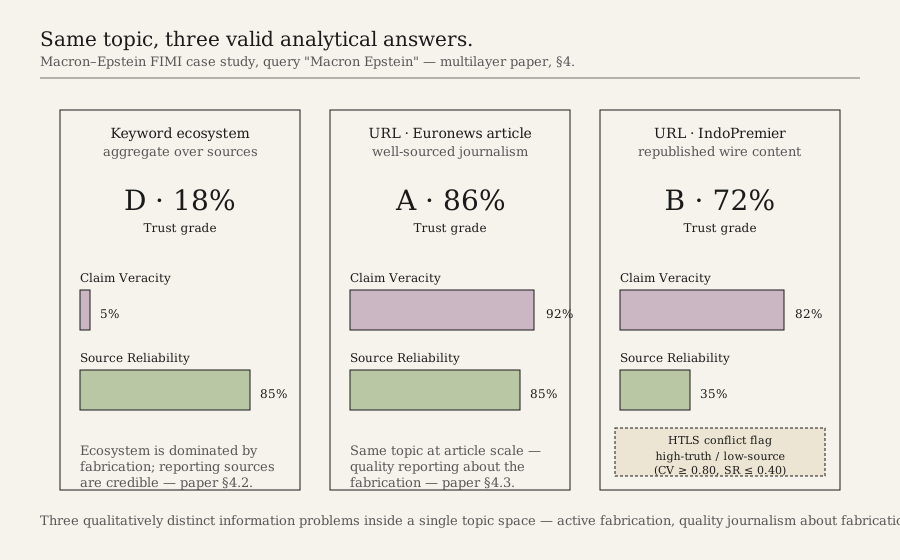
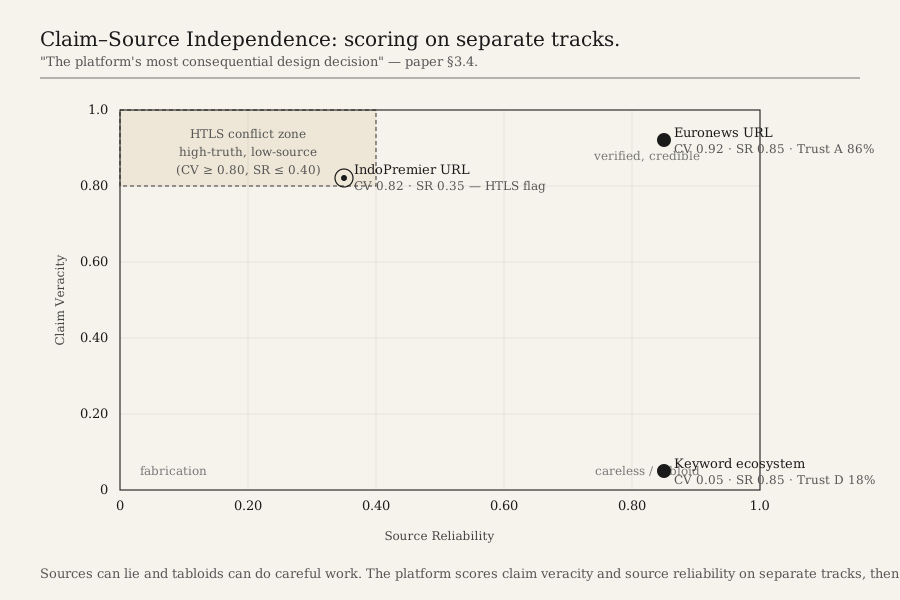
I have spent years next to people whose job is to read the information landscape — newsroom analysts, fact-checkers, intelligence units, civic-tech teams. They almost never need a single magic classifier. They need a stack that respects their workflow: something to scan sources, something to surface narrative drifts, something to leave a clean audit trail. Building that stack as a single big model is what keeps it stuck in the demo phase.
Most papers in this area evaluate a single task on a single benchmark. Real institutional work needs strategic, operational, compliance and collaboration signals at the same time. A single-layer system cannot be optimized for all four without losing one. Our proposal is to give each concern its own surface and its own evaluation criterion, and to make the layers talk to each other through structured signals.
Maryam Fooladi led the operational and strategic side. I co-authored the architecture, mapped the layer interfaces against the workflows of analysts I had worked with, and brought in the compliance and collaboration layers — the two pieces that are usually missing from purely technical pipelines. We also wrote the framework so that a team can adopt one layer at a time, instead of swallowing the whole stack on day one.
Information-landscape work is downstream-accountable. There is always a regulator, an editor or a public asking 'how did you decide that'. A multi-layer architecture is the simplest way I know to give an honest answer. The paper is presented at the Information Disorder Workshop (InDor) at LREC 2026, Palma de Mallorca.