Why Traditional NLP Fails Political News — and How LLMs Can Bridge the Gap
Maryam Fooladi, Federico Bottino
Paper, 3rd Workshop on NLP for Political Sciences (PoliticalNLP 2026) at LREC 2026 — Palma de Mallorca, 2026
Abstract
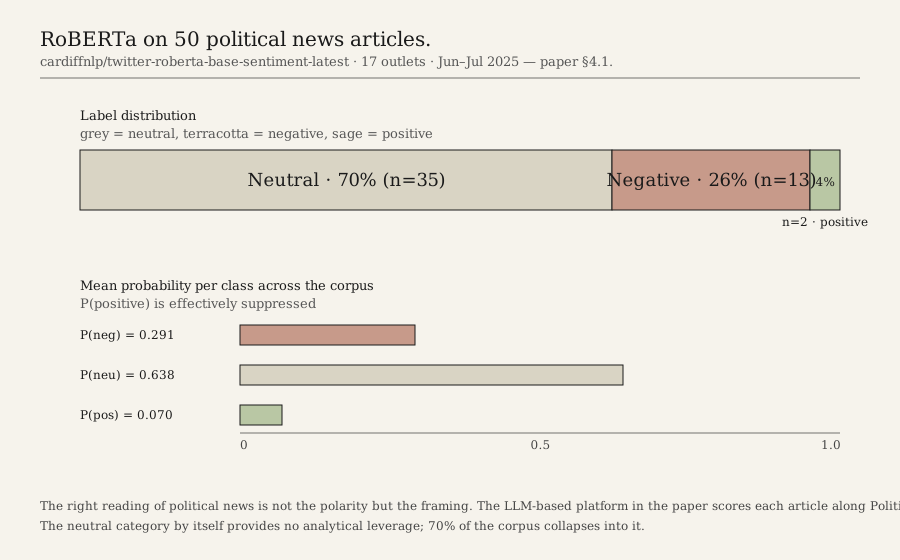
Classical sentiment analysis has been the default lens through which NLP looks at political news for over a decade. It is also the wrong lens. On politically substantive coverage, around 70% of articles get flattened into a single 'neutral' bin — exactly the cases where framing, ideology and rhetorical strategy are doing the work. We systematically compare traditional sentiment pipelines (lexicon-based, fine-tuned transformers) with LLM-based approaches on a corpus of political news. The LLM family does not just score better. It answers a different, more honest question. Where the classical pipeline gives a 3-class verdict (positive / neutral / negative), an LLM-based reading recovers the dimensions political scientists actually use: framing, ideological positioning, rhetorical strategy, stance toward named actors. We propose an evaluation protocol that focuses on the recovery of these dimensions instead of aggregate accuracy, and we publish the comparative results and the prompts used. The paper is a methodological argument as much as an empirical one: if the goal is to study political discourse, sentiment is not the right baseline anymore.
Sentiment is the most over-used tool in political-media analysis. Every team I've worked with — media-literacy NGOs, election-monitoring units, foundations — has at some point shown me a sentiment dashboard and quietly admitted they did not know what to do with it. This paper started from that frustration.
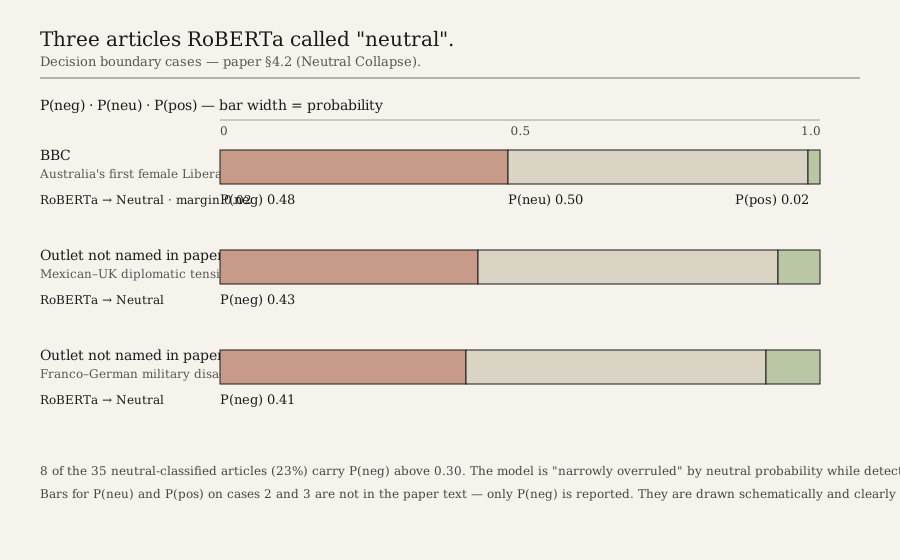
The classical pipeline gives political news a 3-class verdict and lumps about 70% of substantive coverage as 'neutral'. That is not a calibration problem. Political news is not mostly neutral, it is mostly framed. LLMs, used with structured prompts, can decompose the same text into framing, ideological positioning, rhetorical strategy, stance toward named actors. The gain is not a higher accuracy number, it is the recovery of the dimensions political scientists actually use.
Maryam Fooladi led the empirical side. I co-designed the analytic protocol and the evaluation criteria. We built the evaluation around a different question — 'did you recover the right dimensions?' instead of 'did you guess the right class?'. The prompts and the comparative tables are published with the paper, so political-science teams can replicate the pipeline without trusting our numbers on faith.
If the field keeps treating sentiment as the default tool for political news, it will keep producing dashboards nobody acts on. The paper argues for retiring sentiment as the baseline and replacing it with a multi-dimensional, LLM-supported reading. Presented at the 3rd Workshop on NLP for Political Sciences (PoliticalNLP 2026) at LREC 2026, Palma de Mallorca.